How to Write a Rebooking Message Clients Actually Respond To
Most rebooking messages get ignored because of timing and tone, not the offer. Here's what a good one contains, and what to leave out.
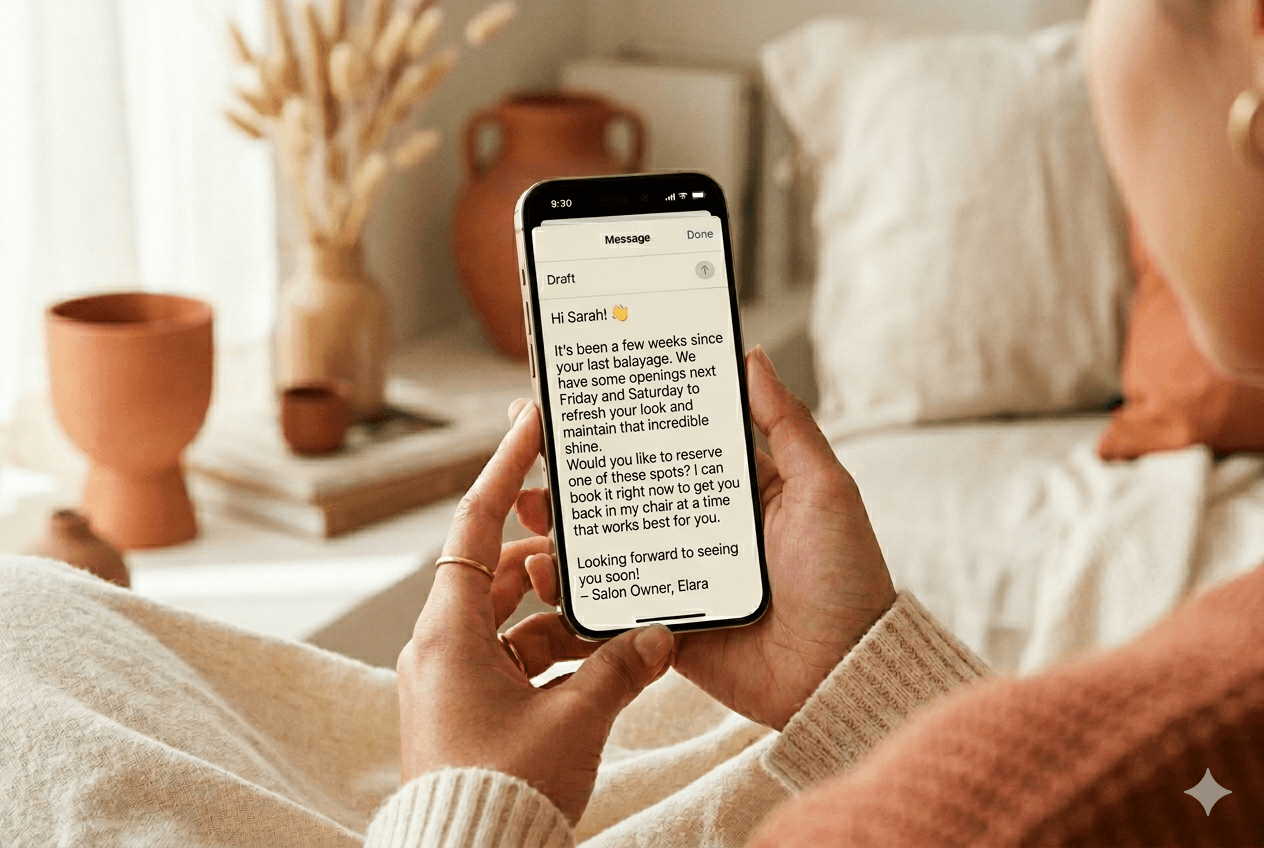
The difference between a rebooking message that gets a booking and one that gets ignored is rarely the offer or the wording. It is almost always the timing.
A perfectly crafted message sent six weeks after an appointment, when the client has already booked elsewhere, will get nothing. A clumsy message sent three weeks after, when the client is just starting to think about their next appointment, will convert.
Get the timing right and the rest is mostly common sense. Get the timing wrong and no amount of clever copy will fix it.
Timing matters more than wording
Most clients have a natural rebooking window of two to three weeks after their last appointment. That is when their nails start growing out, their color starts fading, their lashes start thinning. They are noticing. They are starting to think about it.
If you reach them in that window, the message lands as helpful: a reminder that arrives at the moment they were going to act anyway. If you reach them outside the window, you are either too early (they will not act yet) or too late (they have already booked somewhere else or decided to skip the cycle).
For most beauty services, three weeks post-appointment is the sweet spot. Adjust for your service: lash fills closer to two weeks, color closer to four, haircuts closer to five.
We covered this in why salon clients ghost you. Inertia is the main reason clients drift. A well-timed message recovers a meaningful percentage of them, not because the message is brilliant, but because it reaches them at the moment they were already half-thinking about you.
What a good rebooking message contains
Three elements. In this order.
A specific reference to their last visit. Not "thanks for coming in." Something a touch more personal: the service they got, when they got it, or a small detail. "Hope you're loving the autumn color we did three weeks ago" lands as a real message. "Thanks for being a valued client" lands as a mass email.
A clear next step. A direct booking link. Not "give us a call." Not "stop by anytime." A link that opens to your calendar with available slots already visible. The easier it is to act, the more clients will.
An optional small incentive (use sparingly). A complimentary nail art design, a free upgrade, a small perk. Use this when you have a specific reason: a slow week you need to fill, a new service you want to introduce, or a client who has not been in for a while and you want to reactivate.
Do not use a discount in routine rebooking messages. Once clients learn that waiting longer triggers a discount, you have trained them to wait.
What to never include
A short list.
Don't include a long catch-up. A 200-word message about how spring is here, what new services you're offering, and how much you've missed your clients reads as a newsletter. The client will skim it and move on. Keep the message under 60 words.
Don't include guilt. "We've missed you" or "It's been a while" puts the client on the defensive. They feel bad about not booking, and the bad feeling is now associated with you. Some of them will avoid you to avoid the feeling.
Don't include multiple calls to action. One link. Not "you can also follow us on Instagram, leave a review, or sign up for our newsletter." Every additional ask reduces the chance the client takes the one action you actually wanted.
Don't ask for replies. "Reply YES to confirm" is text-blast tactics. It feels like spam. The action you want is a booking, not a reply.
Subject lines that work
The subject line determines whether the message gets opened. Three patterns that work.
Service-specific. "Time for your next gel manicure?" Tells the client immediately what the message is about.
Soft and friendly. "Quick note from [salon name]" reads like a personal message, not a campaign. Higher open rates, lower booking rates per open, roughly balances out.
Question format. "Ready for your next appointment, Sarah?" The personalization helps. Questions create a small psychological pull to think about an answer.
Avoid subject lines with emoji or excessive punctuation. They read as marketing and get treated accordingly.
The follow-up logic
Most clients respond to the first message or not at all. A second message a week later catches some of the late deciders. A third message becomes pestering.
A good cadence:
- Three weeks after last appointment: first rebooking message
- One week after that, if no booking: a brief follow-up
- Stop
Some salons run quarterly "we miss you" campaigns to clients who haven't booked in 90+ days. These can work, but they're a different tool from the rebooking nudge. They reach clients who have probably already gone elsewhere. Expect lower conversion. Don't blend the two into one campaign.
Automation versus personal
Personal messages convert better. Automated messages reach more people. The right answer is mostly automated with personal touches.
A well-configured automated rebooking system using the client's name, last service, and a direct booking link converts at roughly seventy to eighty percent of the rate of a hand-written message. The volume difference more than makes up for the conversion gap.
What automation cannot do:
- Recognize that a client mentioned a wedding coming up and ask how it went
- Spot a client who is going through something hard and adjust tone
- Skip a client who has explicitly said they're moving away
These are situations where a personal touch matters. The right system is: automation handles the routine cases, and you intervene for the specific ones.
A real example
Here is a workable template. Replace the bracketed parts.
Subject: Time for your next [service]?
Hi [name], hope you've been loving the [service] we did on [date]. Most clients come in for their next [service] around now if they want to keep things looking fresh.
Want to grab a slot? Here's my calendar: [link]
See you soon, [name]
That's 50 words. It's specific, it has a clear action, it doesn't guilt, and the tone is warm without being syrupy.
A message like this, sent automatically at the right window, will convert a meaningful percentage of clients who would have otherwise drifted. That percentage, compounded across your client base over a year, is the difference between a salon that grinds to refill its books every month and one that runs on rhythm.
The rebooking message is doing more work than almost any other piece of communication in your business. It is worth getting right. Most owners spend zero time on it because they assume it doesn't matter. It does.
Built for businesses like yours
Lumidara is the affordable scheduling and client platform for independent salons, nail studios, lash bars, and spas. Free to start. No credit card required.
See how Lumidara works