How to Launch a Loyalty Program Without Overcomplicating It
The biggest threat to a successful loyalty program is overengineering at launch. Here's the minimum viable program that works, and how to expand later.
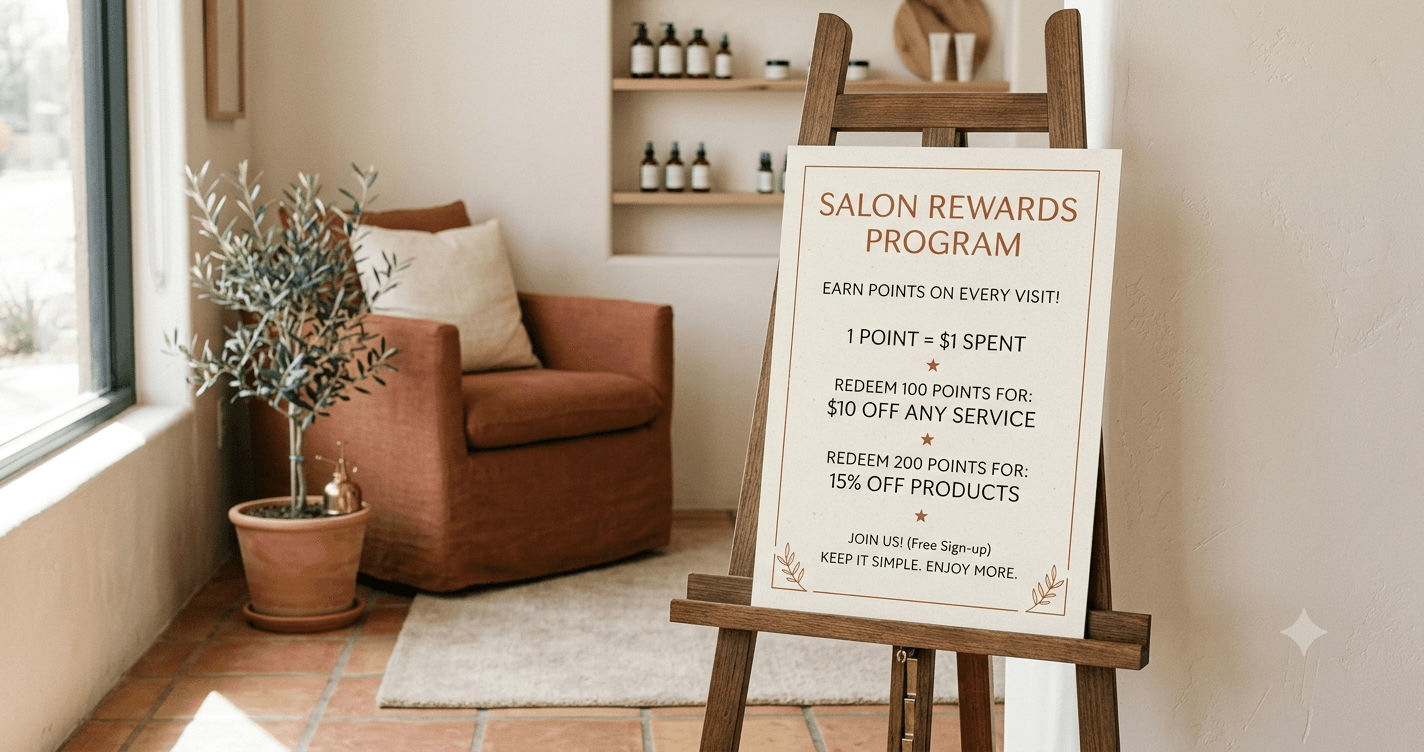
The biggest threat to a successful loyalty program is not the wrong format. It is overengineering at launch.
Owners who design intricate programs with multiple tiers, expiration rules, and category-specific multipliers tend to launch programs that nobody understands and nobody uses. The redemption rate stays in the single digits. The program quietly becomes invisible.
Owners who launch the simplest possible program and let it run unmodified for six months tend to build retention engines that compound for years.
Here is how to launch a loyalty program that actually works.
Start with one tier, one threshold, one reward
The minimum viable program is three things.
One earning rule. "One point per dollar spent." Not "1.5 points per dollar on services over $50." Not "double points on Mondays." A single, dead-simple earning rule that a client can verify in their head at checkout.
One redemption threshold. "200 points equals $10 off." Pick a number that is reachable in two to four visits at average spend. Higher thresholds feel distant. Lower thresholds feel insignificant.
One reward type. A flat dollar discount, a free service upgrade, or a complimentary add-on. Pick whichever fits your business best. Do not offer three different rewards at the same threshold.
This is the entire program. Three sentences. A client should be able to explain it to a friend at brunch without referring to a brochure.
For why this format wins over punch cards, see points vs punch cards. For the broader strategic picture, see loyalty programs for nail salons.
What to skip on day one
A short list of features that sound sophisticated but quietly damage adoption.
Tiers (silver, gold, platinum). Tiers make sense for businesses with very high spend variance across clients. For most small beauty businesses, every regular is in the same tier from the client's perspective. Adding tiers makes the program feel corporate without delivering meaningful behavior change.
Point expirations. Some owners add expirations to "create urgency." What it actually creates is resentment. Clients who lose accumulated points to expiration tend to disengage from the program entirely. If you must expire points, do it gracefully (12+ months of inactivity, generous notice before expiration). Most small businesses are better off skipping expirations entirely.
Service exclusions. "Points don't apply to discounted services" or "Points can't be earned on Tuesdays" are the kinds of rules that make clients feel like they are being tricked. Skip exclusions unless absolutely necessary for margin reasons.
Sign-up forms. Enroll every client automatically at first appointment. Asking clients to opt in adds friction that kills enrollment. Make it the default with an opt-out, not an opt-in.
Multiple redemption tiers. "Redeem 200 points for $10 off, or save up to 500 points for $30 off." The math now requires thinking. Most clients just pick the smallest threshold and redeem. The bigger threshold does not drive behavior, it just clutters the program.
Strip everything down. You can add complexity later if a clear need emerges. You will almost certainly find that you do not need to.
Soft-launch to existing clients first
Do not announce a loyalty program publicly on day one. Start with a soft launch to existing clients.
For each client over the next four weeks, mention it at checkout. "By the way, we've started a points program. You'll automatically earn points on visits going forward. Here's how it works." That is the entire pitch. The client may have a question or two. Answer briefly.
Soft-launching gives you a chance to refine the messaging based on real conversations. You will find out which parts confuse clients, which parts excite them, and which parts you do not need to explain at all.
After four weeks of soft launch with existing clients, you will have a comfortable script and an existing population of enrolled clients. That is when you can mention it on your website, in confirmation emails, and to new clients at their first visit.
How to communicate it at checkout
The checkout conversation matters more than any landing page.
A good script: "You earned 75 points today. You're at 175 toward your next $10 off, which kicks in at 200." Said warmly, like you are sharing good news.
The math is doing the work. The client is hearing that they are 25 points from a real reward. They are motivated to come back sooner.
What not to say: "Don't forget to use your points!" (pressuring), "You can save up to 500 points for a bigger reward" (complicating), "If you refer a friend, you also get bonus points" (mixing programs).
Keep it warm, simple, and about their specific number. Move on.
The first 30 days: watch, do not tweak
Resist the urge to adjust the program in its first month. Owners who tweak too early end up with programs that mean different things to different clients depending on when they enrolled.
What you are watching for.
Enrollment rate. Most clients should be enrolling automatically. If your tool requires opt-in and you are seeing less than 80% enrollment, the friction is too high.
Redemption rate. A healthy program has a redemption rate of 10% to 25% per month. Less than 5% suggests your threshold is too high. More than 30% suggests you may be over-rewarding.
Client conversations. When clients mention the program, are they confused, excited, or indifferent? Confusion means simplify. Excitement means you got it right. Indifference means it is not visible enough at checkout.
After 30 days, you will have enough information to make one or two adjustments if needed. After 90 days, your program should be running on autopilot.
When to consider expansion
A working loyalty program is boring. It runs in the background. Clients accumulate points. They redeem at the threshold. They keep coming back. The program is doing its job quietly.
There is no urgency to add features just because you have gotten comfortable with the basic version. But after a year or two, certain expansions become reasonable.
Birthday bonus points. Annually, around the client's birthday. Adds a personal touch on top of the core program.
Referral integration. Award points (for example, 200 points) when a referred friend completes their first visit. Folds referrals into the same currency.
Anniversary rewards. A small perk on the anniversary of a client's first visit. Surprise gestures land hard.
That is about it. Resist the urge to add tiers, multipliers, or category-specific rules. The program got its results from simplicity. Complexity rarely improves what was working.
The goal of a loyalty program is not to impress clients with sophistication. It is to give them a small, reliable reason to come back. Keep that goal clear and your program will outperform every clever competitor.

Built for businesses like yours
Lumidara is the affordable scheduling and client platform for independent salons, nail studios, lash bars, and spas. Free to start. No credit card required.
See how Lumidara works