How to Build a Beauty Business Website That Actually Books Clients
Most salon websites are digital business cards that nobody books through. Here's what a booking-focused site needs, and when you don't need one at all.
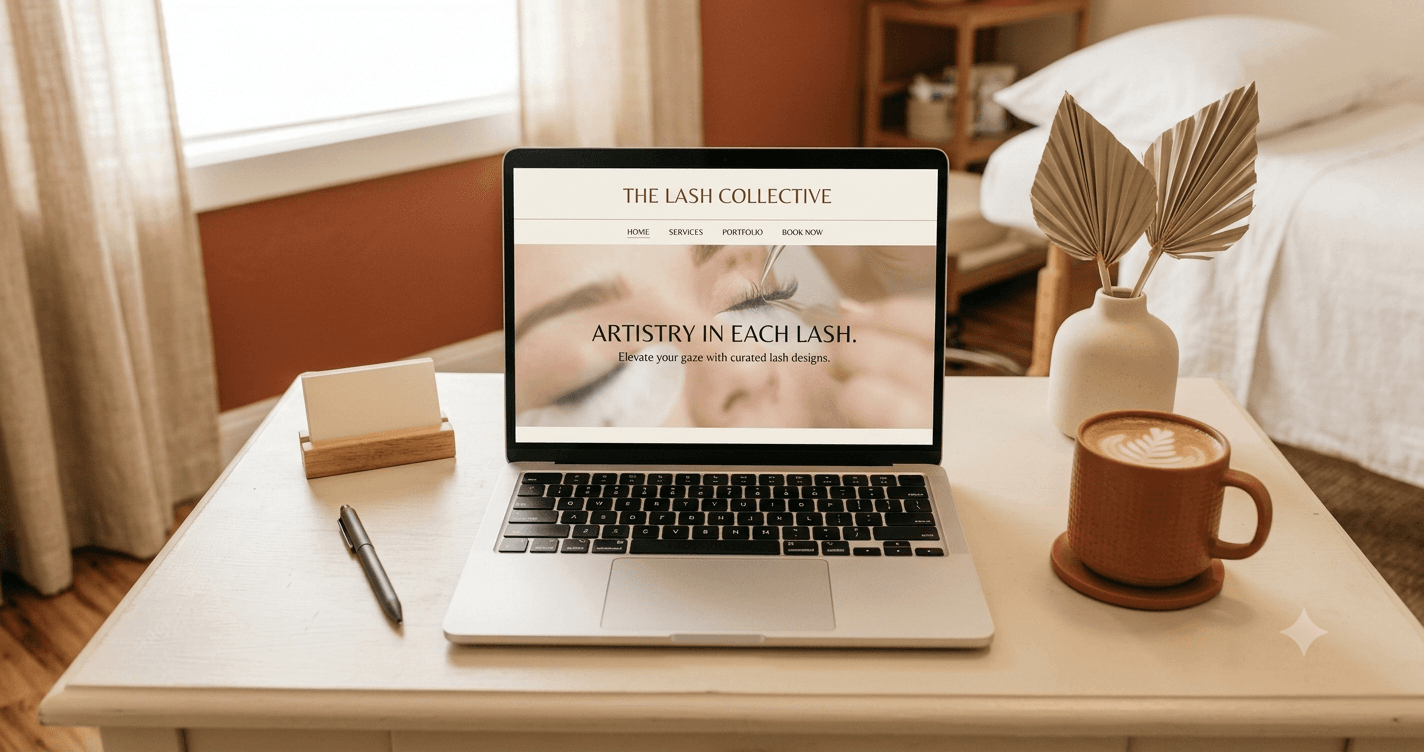
Most beauty business websites are digital business cards. They look reasonable, they took a weekend or a few hundred dollars to produce, and almost nobody books through them.
The reason is usually not design. It is that the site was built to exist rather than built to convert. A site that converts does a small number of things in a specific order, and most of the effort people put into their sites goes somewhere else entirely.
Here is what actually matters, and the case for not building one at all.
Start with the honest question: do you need one?
A dedicated website is worth building when you want control over your brand presentation, when you are running paid traffic to a landing page, or when you have enough services and content that a single booking page cannot carry it.
For a large number of solo operators, a proper website is not the highest-leverage next step. What they actually need is a page that shows their work, lists services and prices, and lets someone book. If your booking tool provides a client-facing page that does those three things, you may already have what a website would have given you.
Lumidara portals, for example, sit at yourstudio.lumidara.com with browsable services, a gallery, an about page, and contact details, and a guest can book without an account. That is a functioning storefront. Plenty of studios run on that plus a strong Google Business Profile and never build anything else.
Build the website when you have a reason beyond "businesses have websites." Otherwise put the time into your portfolio and your reviews, which produce more bookings per hour invested.
If you are building one, the order matters
A page converts in a sequence. Get the sequence wrong and the design work is wasted.
1. Say what you do and where, immediately. Within one second of landing, a visitor should know the service and the city. "Lash extensions in Portland's Alberta Arts District" beats any tagline about confidence or self care. Visitors who cannot place you geographically leave.
2. Put a booking button in the first screenful. Above the fold, visible without scrolling, on mobile. This is the single most common failure. Sites bury booking behind a menu, or place it only at the bottom, and lose the visitors who arrived ready.
3. Show the work early. Beauty is a visual purchase. Six to twelve strong photographs of actual results do more persuading than any amount of copy. Real work only. Stock photography of a generic model reads as untrustworthy the moment a visitor notices it.
4. Make prices visible. Owners resist this constantly, worried about scaring people off. What actually happens is that hidden pricing scares off more people, because uncertainty is worse than a number. Ranges are fine. "Full sets from $180" answers the question without locking you in.
5. Reduce the booking flow to as few steps as possible. Every additional screen, required account, or mandatory field costs you a percentage of visitors. Guest booking, where a first-timer can complete without creating a password, converts materially better than forced account creation.
Everything else, the about page, the philosophy, the blog, is optional and secondary.
The mobile reality
Well over half of your visitors, and often far more, arrive on a phone. Frequently at night, frequently in bed, frequently with a friend's recommendation still open in another tab.
That means the phone version is the real site and the desktop version is the courtesy version. Test on an actual phone, not a browser window resized to look narrow. Check that the booking button is reachable with a thumb, that text is legible without zooming, and that images do not take eight seconds to load on a mediocre connection.
Page speed is a conversion issue before it is an SEO issue. A visitor who waits five seconds for hero images to appear is a visitor who has already gone back to Instagram.
What to skip
A short list of things that consume enormous effort and produce very little.
Auto-playing video backgrounds. Slow, distracting, and they push your booking button off the first screen.
A long founder story on the home page. Your story is good and it belongs on the about page. A visitor deciding whether to book a fill does not need your origin narrative first.
Elaborate animations. They add load time and cognitive noise. Nobody has ever booked because a section faded in nicely.
A newsletter popup on arrival. You are asking for a commitment before you have given the visitor anything. If you want emails, ask after they book.
Custom design when a good template exists. Unless design is central to your positioning, a well-chosen template with your real photography will convert as well as something custom, at a fraction of the cost and time.
The SEO minimum
You do not need a content strategy. You need the basics done properly.
Include your city and service in the page title and the main heading. Add your full address and phone number in the same format as your Google Business Profile, since consistency between them helps local ranking. Give every image a descriptive filename and alt text. Make sure the site is served over HTTPS and loads quickly on mobile.
Then claim and complete your Google Business Profile, which for a local service business will almost always deliver more search traffic than the website itself. Reviews and profile completeness matter more than anything you will do on your own domain in the first year.
Connecting the site to your booking tool
Two approaches, and the difference matters.
Link out to your booking page. Simplest and most reliable. The button goes to your booking tool, which handles availability, confirmations, and reminders. Visitors experience a brief handoff to another domain, which is a small cost and rarely a real problem.
Embed the booking widget. Keeps visitors on your domain. Looks more integrated. Adds a dependency and occasionally breaks in ways that are difficult to diagnose, particularly on mobile Safari.
For most small operators, linking out is the right call. It fails less, and the handoff costs you far less than a broken embed does.
Whichever you choose, verify the whole path end to end on a phone at least twice a year. Booking flows break silently, and the failure mode is invisible: nobody emails to tell you the button did not work.
The measurement that matters
Not visitors. Bookings.
If you track anything, track how many people land on the site and how many complete a booking. That single ratio tells you whether the page is doing its job. Everything else, including traffic volume, is context.
A site with two hundred visitors a month and a twelve percent booking rate is dramatically healthier than a site with two thousand visitors and a one percent rate. The first one is working. The second one has a conversion problem that more traffic will not fix.
For the wider picture of which numbers deserve your attention, see what every solo beauty pro should track.

Built for businesses like yours
Lumidara is the affordable scheduling and client platform for independent salons, nail studios, lash bars, and spas. Free to start. No credit card required.
See how Lumidara works