Consultation and Intake Forms: Getting the First Visit Right
A good intake form prevents mismatched expectations, protects you legally, and makes clients feel cared for. Here's what to include and what to leave out.
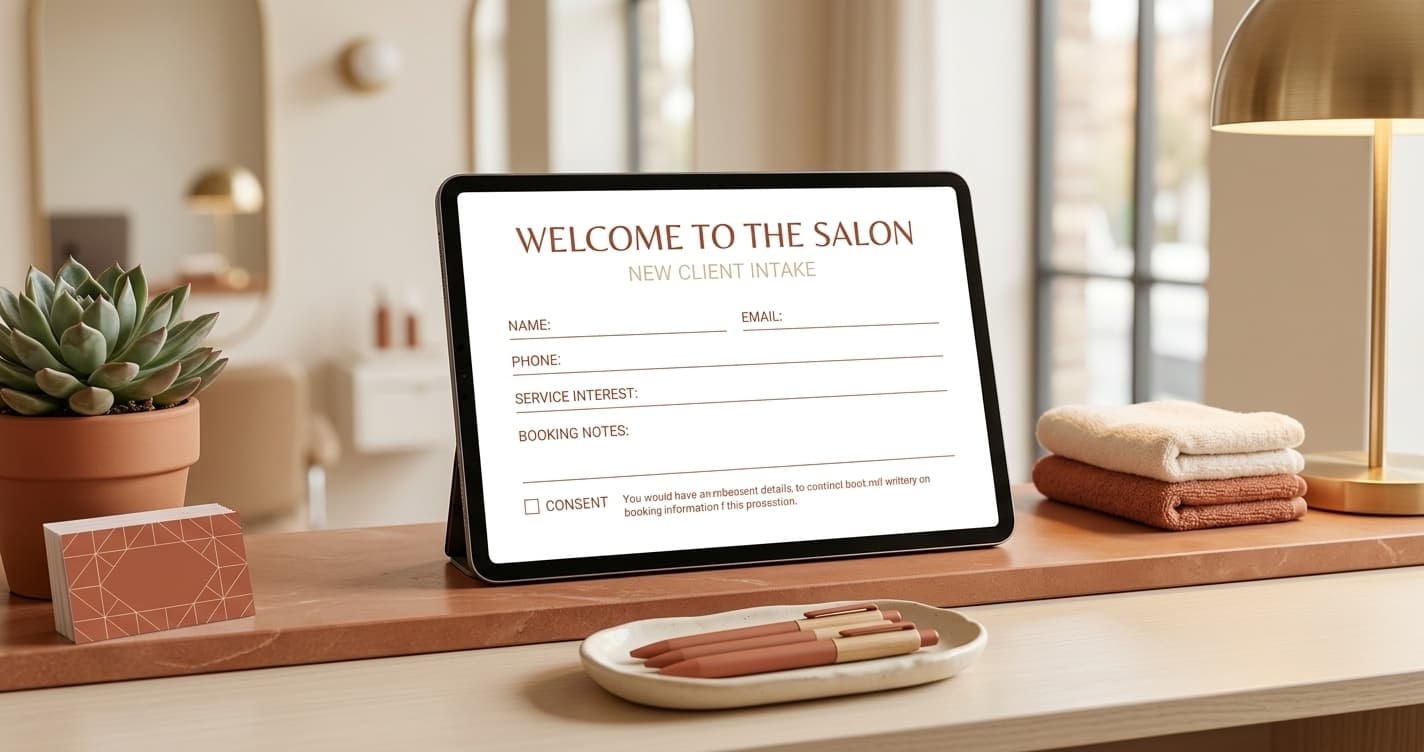
The intake form is one of the most underused tools in a beauty business. Done well, it prevents mismatched expectations, protects you legally, captures the information that makes service and retention better, and signals to a new client that you are thorough and professional before you have touched their hair.
Done poorly, it is either skipped entirely, leaving you flying blind on a first visit, or it is a bloated wall of questions that annoys the client and gets half-answered.
Here is how to build one that earns its place.
What the form is actually for
An intake form serves four distinct purposes, and it helps to be clear about which questions serve which.
Getting the service right. What the client wants, what they have had before, what they liked and did not like, their history with the service. This is the information that prevents the single most common first-visit failure: delivering something the client did not actually want.
Protecting you. Allergies, sensitivities, medical conditions relevant to the service, past reactions. For services involving chemicals, adhesives, or skin, this is not optional. It is how you avoid harming a client and how you demonstrate due diligence if something goes wrong.
Building the relationship. Contact details, birthday, communication preferences, how they found you. The information that lets you follow up, remember them, and market appropriately later.
Consent. Permission to photograph, acknowledgment of policies, agreement to the terms of the service. Handled once, up front, cleanly.
Every question on your form should map to one of these four. If a question does not, cut it.
What to include
The specifics vary by service, but a strong general intake form covers:
Basic details. Name, phone, email, and birthday. The birthday is worth capturing here because it powers birthday rewards later, and clients give it up readily when asked as a normal field.
How they found you. A single question that quietly tells you which of your marketing channels actually works. Referrals, Instagram, Google, walk-by. Over time this is genuinely useful data.
Service goals. What are they hoping for today. Open enough to let them describe it in their own words, since that is where mismatches get caught early.
Relevant history. What they have had done before, what worked, what did not. For color, chemical history is essential. For lashes, past reactions and what style they have worn.
Health and safety. Allergies, sensitivities, and any medical conditions relevant to the service. Keep this tightly scoped to what actually affects the service. You are not running a clinic, and asking for irrelevant medical detail is both off-putting and a data-handling burden you do not want.
Preferences. Anything that improves the experience: conversation preference, sensitivities to product smells, scheduling constraints.
Consent and policies. Photo permission, acknowledgment of your cancellation policy, and agreement to any service-specific terms.
What to leave out
The temptation is to ask everything you might ever want to know. Resist it. A long form has real costs: clients abandon it, rush it, or resent it, and every extra field is data you are now responsible for handling.
Cut anything that does not serve one of the four purposes. Cut questions you will never actually look at. Cut medical questions that have no bearing on your service. Cut anything that feels invasive relative to the service being provided. A nail appointment does not need a medical history a surgeon would ask for.
The best forms are surprisingly short. They capture what matters and nothing else, which is exactly why clients actually complete them.
Digital beats paper
Paper intake forms create work: someone has to store them, find them, and eventually they get lost or coffee-stained. A digital form solves several problems at once.
It can be completed before the appointment, from the client's phone, which saves time in the chair and lets you review it in advance. It stores the information where you can actually find it later. It attaches to the client's record so the history is there at the next visit. And it handles consent and policy acknowledgment cleanly, with a timestamp.
Sending the form as part of the booking confirmation for new clients is the smoothest approach. The client completes it at their leisure, you review it before they arrive, and the first visit starts with you already understanding what they want. If your booking or client tools capture this information into the client record, even better, because it compounds over time into the kind of history that makes a client feel known.
The form is not the consultation
An important distinction: the intake form gathers information. It does not replace the conversation.
Even with a thorough form, the first visit still needs a real consultation, a spoken exchange where you confirm what you read, ask follow-up questions, and manage expectations face to face. The form makes that conversation better and shorter by giving you a starting point. It does not make it unnecessary.
The failure mode is treating a completed form as sufficient and skipping the human check-in. The client wrote "a trim and some layers," but what they picture and what you picture may differ, and only the conversation surfaces that gap. We covered why this matters in how to turn a first-time client into a regular: the consultation is where trust is built or lost, and the form is its foundation, not its substitute.
Handle the information responsibly
An intake form collects personal information, some of it sensitive. Treat it with care.
Store it somewhere secure rather than in a shoebox or an unsecured spreadsheet. Collect only what you need, which is another reason to keep the form short. Do not share it. And if you operate anywhere with specific data or health-information rules, understand what applies to you. For most independent beauty businesses collecting basic service-relevant information this is straightforward, but the principle of collecting less and protecting what you collect always holds.
If your service genuinely involves health information at a clinical level, medical aesthetics for example, the requirements are more stringent and you should get specific guidance rather than relying on a general template.
Keep it current
An intake form is not a one-time capture. Preferences change, contact details change, and for services with health relevance, conditions change.
For regular clients, a light periodic refresh (confirming details are current, updating anything relevant) keeps the information useful and shows continued attentiveness. It does not need to be a full re-intake every visit, just a habit of keeping the record accurate.
A good intake form is a small thing that quietly makes everything downstream better: the service is more accurate, the client feels cared for, you are protected, and the relationship has a foundation of real information rather than guesswork. Five minutes of the client's time, set up once, paying off for years.


Built for businesses like yours
Lumidara is the affordable scheduling and client platform for independent salons, nail studios, lash bars, and spas. Free to start. No credit card required.
See how Lumidara works